
Why the Beautiful Game Must Always Be Bigger Than Politics
Futbol (Soccer in USA) is called the beautiful game because, at its best, it represents fairness, merit, teamwork, and respect. Every four years, billions of people gather around televisions and phones to watch nations compete, believing that the outcome will be decided by the players on the field, the judgment of the referees, and the rules that everyone has agreed to follow.
Fans understand that referees are human and that controversial calls are part of the sport. Sometimes those decisions benefit your team, and sometimes they don’t. That uncertainty is part of what makes competition meaningful.
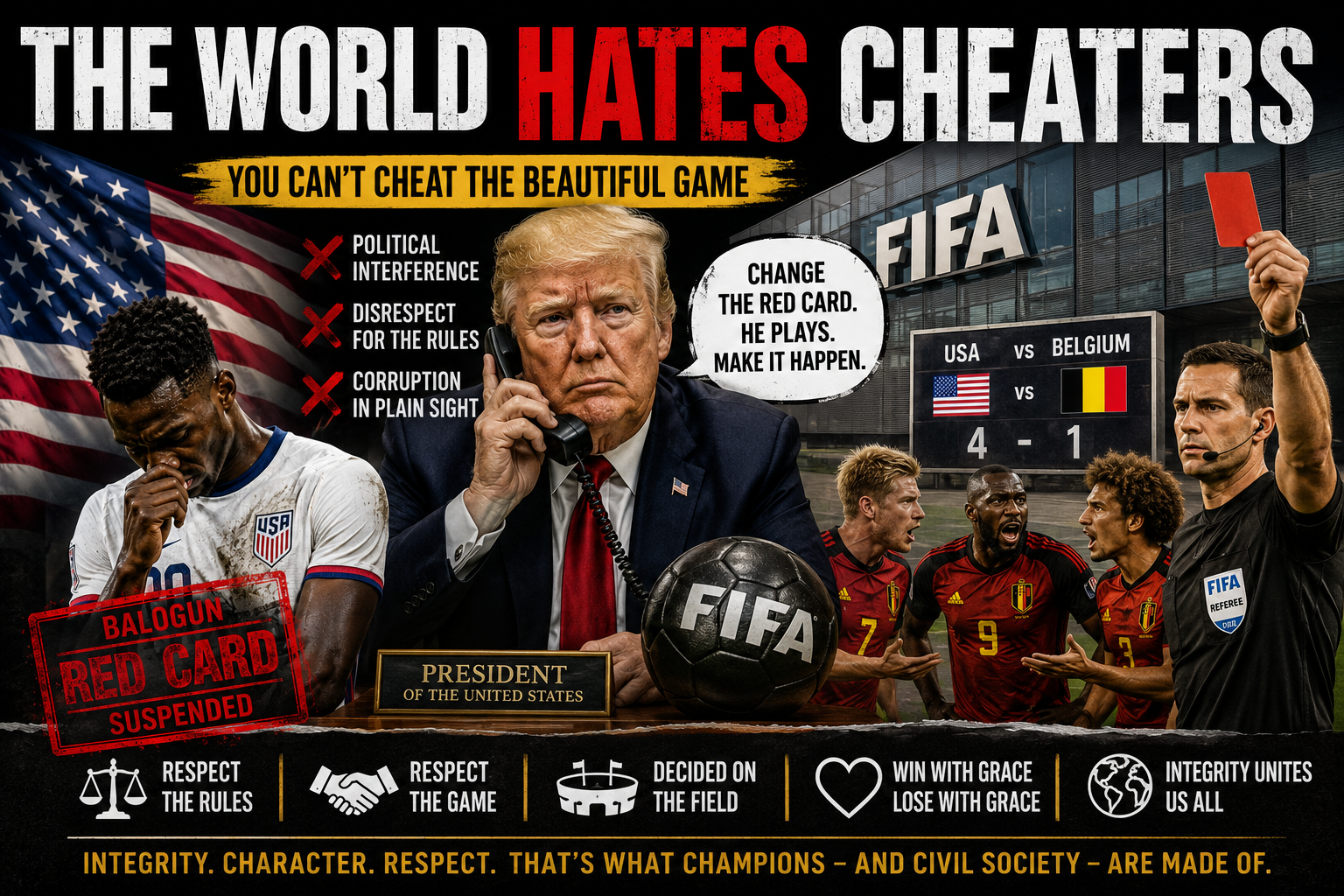
The controversy surrounding the reversal of Folarin Balogun’s suspension before the United States–Belgium match inspired me to write my new song, “You Can’t Cheat the Beautiful Game.” Reports and public discussion about political involvement in the decision sparked a debate that extends far beyond a single match.
Regardless of how people interpret every detail of what happened, the larger question deserves serious consideration: should political leaders ever attempt to influence the outcome of sporting competitions? My answer is no. The moment political power appears to interfere with independent sporting decisions, the credibility of the competition itself is placed at risk.
When Trump Called FIFA (You Can’t Cheat The Beautiful) – Johnny Punish – Reggae Ska
The saddest part of controversies like this is that the players are often the ones who pay the highest price. They train for years to represent their countries, only to find themselves caught in a political storm they never created.
Instead of talking about tactics, teamwork, and athletic performance, the conversation shifts to accusations, controversy, and public distrust. Whether they benefited from the decision or not, the athletes inherit a burden that should never have been theirs to carry.

Sports teach lessons that extend well beyond the stadium. They teach discipline, perseverance, resilience, and respect for opponents. They also teach us that rules matter because they apply equally to everyone.

When powerful people begin acting as though the rules should bend for them simply because of who they are, they undermine one of the most important principles of both sport and democracy: equality under the rules. It is not enough to win. The manner in which victory is achieved determines whether it is respected.
One of the most dangerous ideas any leader can promote is the belief that only they know the truth, only they understand the rules, and only they can decide what is fair. Healthy societies do not function that way. They depend on independent institutions, shared standards, and the willingness of leaders to accept decisions even when those decisions are unpopular or inconvenient. That same principle applies on the football pitch.
Referees may make mistakes, but allowing political influence to override the established process would create something far worse than a mistaken call—it would create a competition where influence matters more than performance.
For generations, writers like Dale Carnegie reminded us that successful leadership begins with humility and respect. Listen before speaking. Treat people with dignity. Seek cooperation rather than domination. Respect those who disagree with you. These ideas helped build strong communities because they recognize a simple truth: character matters. Strength without humility becomes arrogance. Confidence without integrity becomes corruption. Winning without honor eventually becomes hollow.

Over the past decade, public life has too often rewarded insults over dialogue, outrage over understanding, and personal loyalty over institutional integrity. We have become accustomed to seeing rules questioned whenever they produce an unfavorable outcome and dismissed whenever they become inconvenient.
That mentality is corrosive because it teaches people that fairness is optional and that power is its own justification. History repeatedly demonstrates that societies built on those assumptions eventually lose the trust that holds them together.

The world does not admire cheaters. It admires people who compete honestly, accept defeat with grace, and return stronger the next time. The greatest champions are remembered not simply because they won, but because they won with integrity.
Likewise, the greatest nations earn respect not by demanding special treatment but by demonstrating that they are willing to compete under the same rules as everyone else.
That is the message behind “You Can’t Cheat the Beautiful Game.”
The song is not simply about one football match or one political controversy. It is about a principle that applies everywhere: in sports, in business, in government, and in everyday life. Fairness is not a weakness. Integrity is not old-fashioned. Character still matters. When the final whistle blows, trophies may gather dust and headlines may fade, but the way we choose to compete will always define who we are.
⚽ Sometimes a futbol match becomes bigger than futbol (soccer). “You Can’t Cheat the Beautiful Game” is a reggae-ska protest anthem inspired by the controversy surrounding the reversal of Folarin Balogun’s suspension before the United States–Belgium match. Rather than celebrating politics or picking sides on the pitch, this song asks a simple question:
Should power ever influence the outcome of sport? This is a song about integrity, sportsmanship, and the belief that championships should be won by the players on the field—not by influence behind the scenes.
To the players who were caught in the middle, this song carries empathy. To those who believe fairness is optional, it offers a reminder: Honor can’t be bought. Respect can’t be demanded. And you can’t cheat the beautiful game.
LYRICS
La-la-la-long long long
La-la-la-long yeah
Whoa-oh-oh
The whole world watchin’ now
Well a football game should settle on the field
Not behind closed doors where the powerful deal
The players came ready heart and soul
Then somebody reached for another man’s goal
One phone call one mighty hand
Trying to rewrite what the referee planned
But truth don’t bend when the cameras roll
You can’t buy spirit you can’t buy soul
La-la-la-long long long
Right is right wrong is wrong
La-la-la-long long long
Justice always sings its song
You can’t cheat the beautiful game!
No matter how famous your face or your name
Whoa-oh-oh hear the people sing
Honor is the only king!
La-la-la-long long long
Play it fair play it strong
La-la-la-long long long
Truth will live when the lies are gone
Feel for the players caught in the storm
Never asked to wear another man’s scorn
They came for glory not political games
Now they’re carrying someone else’s shame
Across the field the Red Devils rise
Fire in their hearts and truth in their eyes
Every tackle every pass every run
Showed the world how victory’s won
La-la-la-long long long
You can’t fake where you belong
La-la-la-long long long
Character will carry on
You can’t cheat the beautiful game!
No matter how famous your face or your name
Whoa-oh-oh hear the people sing
Honor is the only king!
La-la-la-long long long
Play it fair play it strong
La-la-la-long long long
Truth will live when the lies are gone
A leader should lead not interfere
Bring us together not feed our fear
Respect is something you never command
It’s earned by the heart not forced by the hand
La-la-la-long
One love one game
La-la-la-long
Honor over fame
La-la-la-long
No shortcuts today
Let the best team win
That’s the only way!
You can’t cheat the beautiful game!
No matter your power no matter your name!
The final whistle tells no lies
Truth is written in the skies
La-la-la-long long long
Sing it loud sing it strong
La-la-la-long long long
Justice is the champion!
La-la-la-long long long
The whole world keeps watchin’ on
La-la-la-long long long
Play it fair and carry on
______________________
🎵 Written & Produced by Johnny Punish
#JohnnyPunish #Reggae #Ska #Futball #Soccer #FIFA #Sportsmanship #ProtestSong #PoliticalMusic #BeautifulGame #Truth #Integrity