
His silence on Gaza has become louder than any song he ever wrote
I’ve loved Morrissey’s music for most of my life. His songs weren’t just songs—they were companions. They gave lonely people a language. They spoke for outsiders, misfits, dreamers, and anyone who ever felt invisible. Morrissey taught an entire generation that compassion belongs with those the world forgets. That’s why writing this hurts. This isn’t an attack. It’s a disappointment. A profound one.
Morrissey has never hidden his admiration for Israel. He has performed there despite international boycott campaigns, praised Israeli audiences, rejected cultural boycotts, and made it clear where his sympathies lie. He has every right to those views. That isn’t what troubles me. What troubles me is what he never said.
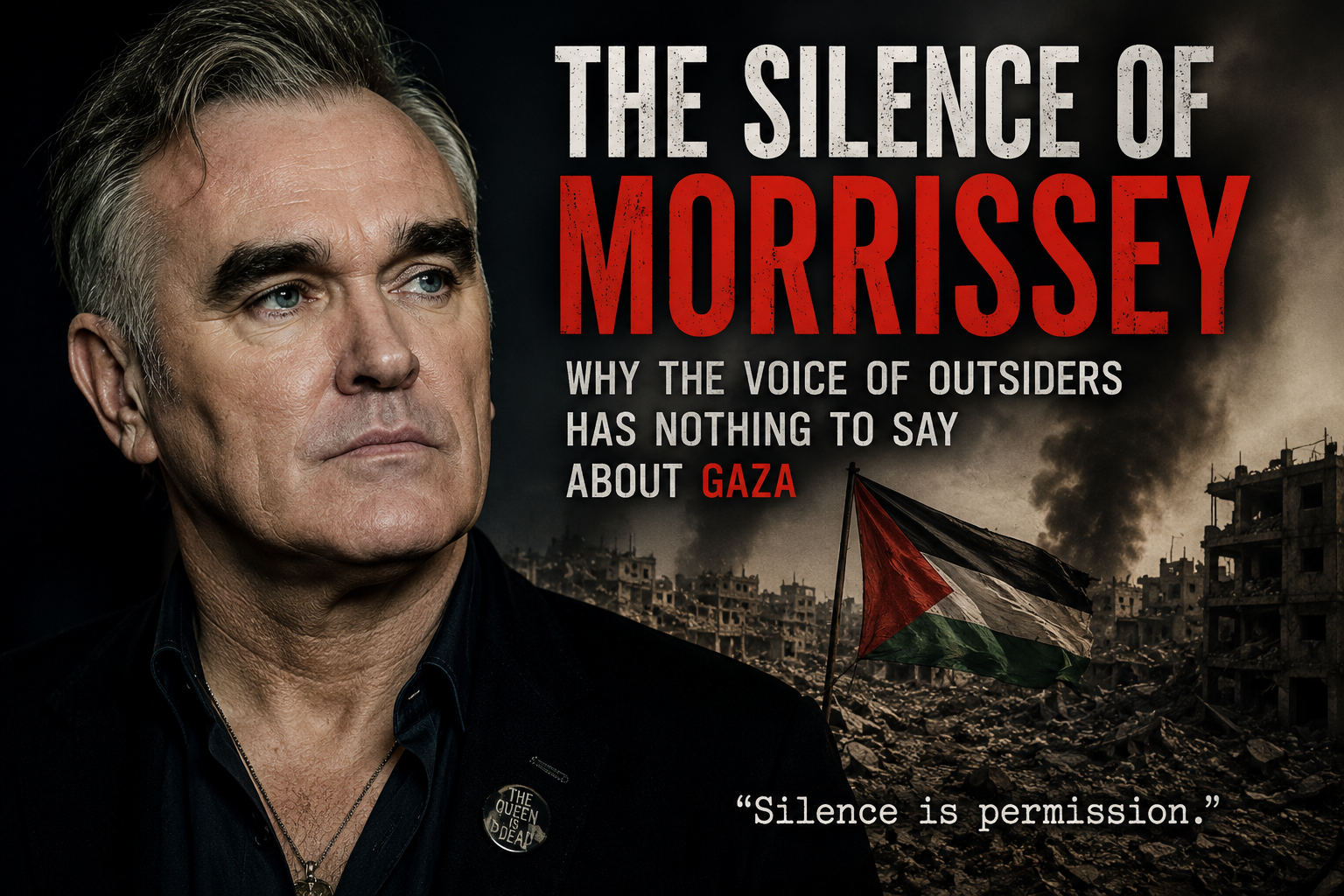
As Gaza became synonymous with bombed neighborhoods, displaced families, devastated hospitals, and children pulled from beneath collapsed buildings, one of the greatest lyricists of our time seemed to disappear. The man who always had something to say suddenly had almost nothing to say. That silence became louder than any chorus he ever wrote.
People will immediately object. They’ll say Morrissey never supported killing Palestinians. They’ll point out that he never called for violence, never expressed hatred toward Palestinians, and never openly celebrated the destruction in Gaza. That’s true. He didn’t. But that’s not the point.
The point is that silence has consequences.
When millions of people witness immense civilian suffering and one of the world’s most outspoken artists chooses not to publicly acknowledge it, that silence doesn’t exist in a vacuum. It becomes part of the story. Whether that silence comes from fear, loyalty, political conviction, exhaustion, or something else entirely, I cannot know. I don’t pretend to know what is inside Morrissey’s heart. I only know how his silence sounds.

To me, it sounds like permission.
In one of my own songs I wrote the line, “Silence is permission.” I still believe that—not because silence proves someone’s motives, but because silence from influential voices allows injustice to continue without challenge. History remembers the people who spoke. It also remembers the people who didn’t.
Want The Rest of This Story?
The complete article continues inside The Punish Underground