
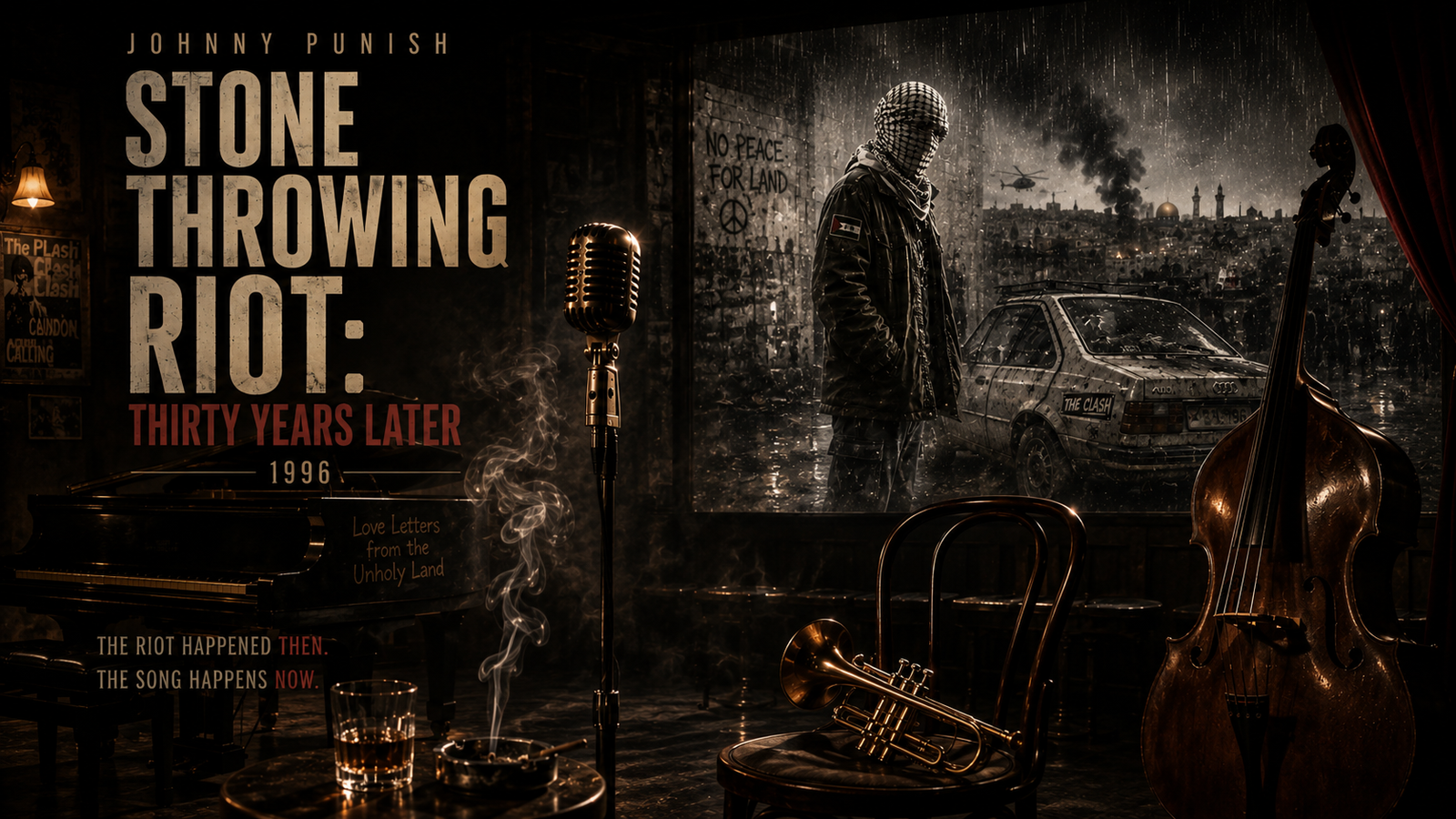
Some songs refuse to stay buried. Not because they were hits or because they changed the world, but because the questions they ask never seem to go away. “Stone Throwing Riot: Thirty Years Later” is one of those songs.
Back in 1996, I was the lead singer of a punk rock band called Twisted Nixon. Like many young musicians, we were angry, idealistic, and trying to make sense of a complicated world. One of the songs we wrote was called “Stone Throwing Riot“. It was loud, fast, confrontational, and unapologetically punk rock. It was inspired by the images coming out of the First Intifada and by a conflict that already seemed ancient even then. We weren’t trying to solve anything. We were trying to understand it.
Thirty years later, I found myself revisiting the song. Not because I wanted to relive my youth, and not because I wanted to remake a punk anthem. The original still exists and belongs to that era. What interested me was something else entirely. The conflict that inspired the song had never really gone away.
The names in the headlines changed. The politicians changed. The technology changed. Yet the underlying questions remained remarkably familiar. Revisiting the song wasn’t an exercise in nostalgia. It was an acknowledgment that some stories continue long after the people who first told them have grown older.
The biggest difference between the 1996 version and the 2026 version isn’t the lyrics. It’s perspective. When you’re young, history feels immediate and urgent. When you’re older, history starts to look like a series of repeating patterns. You begin to notice how generations inherit conflicts they didn’t create, how old wounds are passed down, and how narratives become more complicated the deeper you look. Age has a way of slowing the tempo without softening the truth.
Part of the mythology surrounding the original song involves a mysterious character named Joe Allen. At least that’s what he called himself. Nobody really knew where he came from. He always seemed to appear whenever conversations turned toward Palestine, Israel, resistance, injustice, or history. He wore a keffiyeh over his face long before most Americans knew what one was, spoke passionately about events half a world away, and then vanished as mysteriously as he arrived.

Want The Rest of This Story?
The complete article continues inside The Punish Underground