

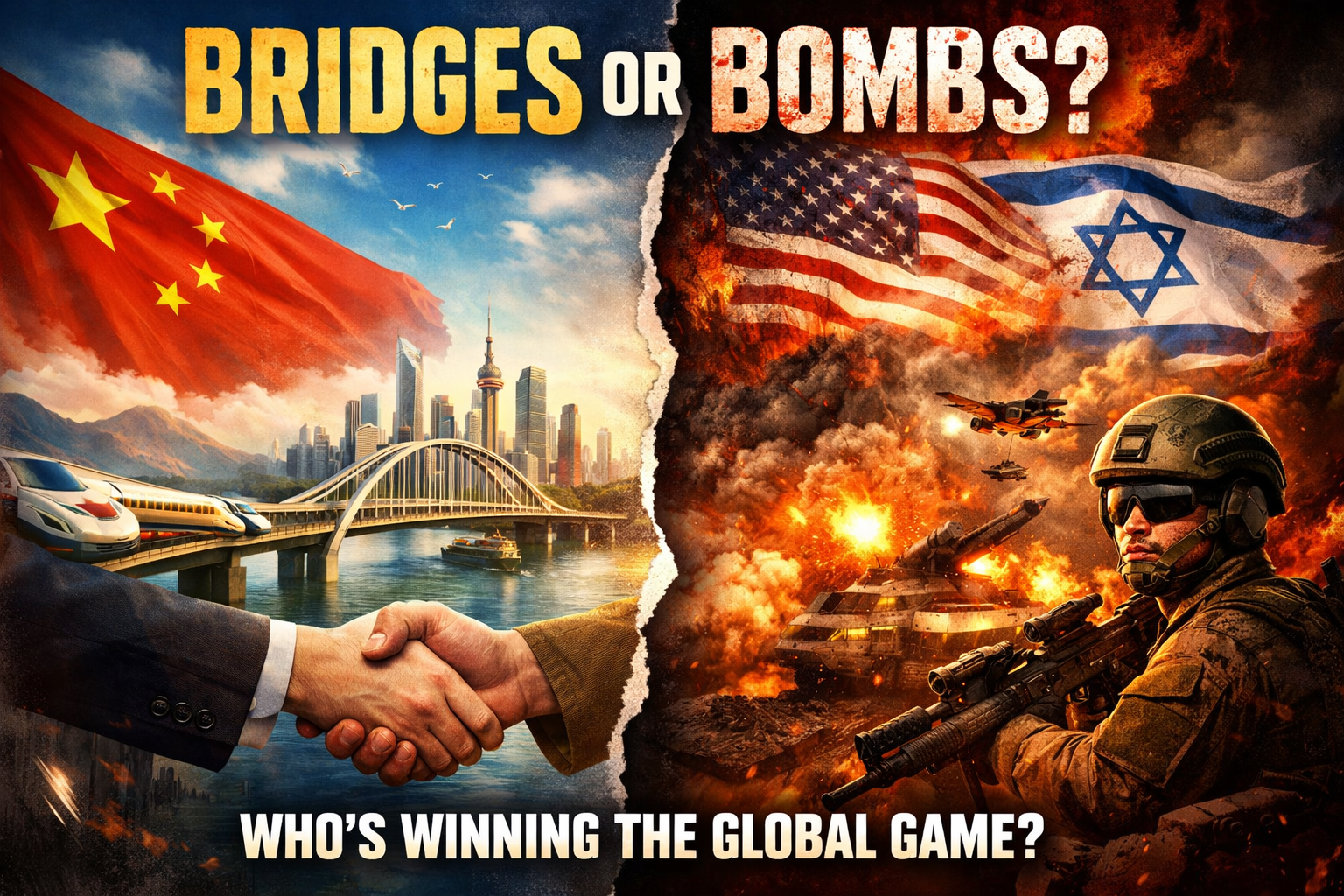
IN OUR FACES: THE EVIDENCE IS EVERYWHERE! GAME OVER! JUST TAKE A LOOK!
by Johnny Punish
What we are witnessing today on the global stage is not chaos—it’s contrast. Two fundamentally different strategies are unfolding in real time, each aiming for influence, dominance, and long-term power. But while their goals may be similar, their methods—and ultimately their outcomes—are diverging sharply.
On one side, there is the strategy of connection: building bridges, forming partnerships, and expanding influence through trade, infrastructure, and cooperation. This is the path China has chosen. It is methodical, patient, and rooted in mutual benefit—at least in appearance and execution.
On the other side, there is the strategy of coercion: projecting power through military dominance, enforcing order through strength, and expecting alignment through pressure. This is the path increasingly associated with the United States and its strategic partner, Israel, with which it is so intertwined that they are now one nation, which I now call “USrael”.
The Bridge-Building Model
China’s approach is simple in concept but powerful in execution: create economic interdependence, and influence will follow. From Europe to the Middle East to Latin America, China is investing, trading, and embedding itself into the infrastructure of the global economy.
Here in Mexico, for example, consumers are already benefiting from affordable, technologically advanced Chinese vehicles. While USrael resists or restricts these imports, China expands its footprint—quietly but effectively.
This is not accidental. It is a strategy.

By building roads, ports, trade agreements, and supply chains, China is not just participating in globalization—it is reshaping it. Each partnership becomes another thread in a growing web of influence.
The Coercion Model
In contrast, USrael increasingly projects a worldview centered on military superiority. The underlying message—whether explicitly stated or implicitly understood—is this: we possess the power, and therefore we set the terms.
This approach assumes that strength alone can secure compliance, loyalty, or alignment. But in a world that is more interconnected than ever, coercion often produces the opposite effect: resistance, fragmentation, and isolation.
Nations may cooperate out of necessity, but rarely out of trust.
Lessons from Brexit and Beyond
We have already seen what happens when fear of globalization drives strategy. Brexit was, at its core, a retreat—an attempt to reclaim sovereignty by stepping away from interconnected systems. The result has been economic strain, political complexity, and diminished influence.
A similar mindset is emerging elsewhere: a belief that disengagement, protectionism, and unilateral action can restore dominance. But the global system has evolved. Power is no longer defined solely by military capability—it is defined by networks, relationships, and economic integration.
One Outcome Is Emerging
Despite these opposing strategies, they are converging toward a single outcome: alignment versus isolation.
China is positioning itself as a partner to many. The United States and Israel risk positioning themselves as powers that act independently of global consensus.
Over time, nations gravitate toward opportunity, not pressure. They align with those who offer growth, access, and collaboration—not those who demand compliance.
Reckless rhetoric—especially statements like “A civilization will die tonight,” attributed to Donald Trump—does more than provoke headlines. It erodes trust, damages credibility, and weakens the ability of USrael to build meaningful global relationships. Language like this doesn’t project strength—it signals instability. In short, that’s what losers do.
That very dynamic inspired my latest track, Empire of Ash—a song that captures the consequences of power driven by ego, fear, and destruction. If this message resonates, the music takes it even further.
The Future Will Reward Builders
History consistently favors those who build rather than those who dominate. Empires that rely too heavily on force tend to overextend, while those that cultivate alliances tend to endure.
This is not a prediction rooted in ideology—it is a pattern observed across centuries.
If current trajectories hold, and all evidence suggests it will, the gap will widen. China will continue expanding its network of partnerships, while USrael find themselves increasingly alone, facing the consequences of strategic choices rooted in dominance rather than cooperation.
The future will not be decided by who can command the most fear.
It will be decided by who can build the most trust.