

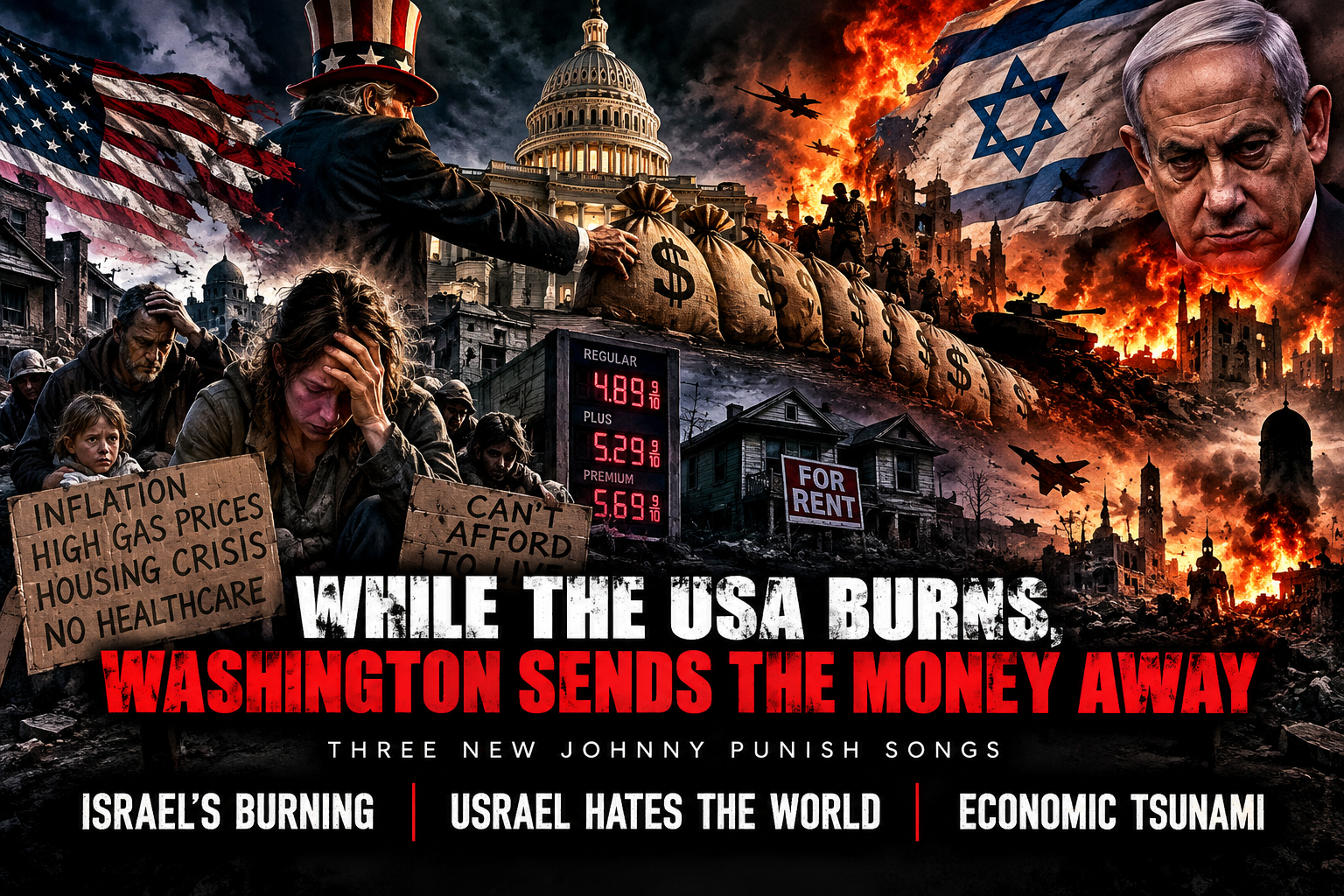
There is a question becoming harder and harder for people in the United States to avoid: What exactly is the US government spending its money on — and why does there always seem to be money for war and genocide while there is never enough money for the people who actually live in the USA?
That question sits at the center of three new Johnny Punish songs: “Israel’s Burning,” “USrael Hates the World,” and “Economic Tsunami.” These aren’t three unrelated songs. They’re three pieces of the same argument — an argument about priorities, power, war, money, and the growing disconnect between what Washington is willing to finance overseas and what ordinary people in the United States are struggling to afford at home.
Let’s start with something that doesn’t come from me. It comes from the public.
In 2026, polling has shown enormous concern among people in the United States about the cost of everyday life. Pew Research Center reported in July that 69% were very concerned about healthcare costs, 66% about food and consumer-goods prices, 64% about housing, and 56% about gasoline. By April, Pew found that 73% considered the affordability of healthcare a very big problem, while 66% said the same about inflation.
So let’s be clear: people are hurting.
Housing is expensive. Healthcare is expensive. Food is expensive. Gasoline is expensive. Everything feels more expensive. Millions of people are asking themselves how they are supposed to keep up.
And then they look at Washington. And they see billions of dollars continuing to flow into foreign military operations. That’s where the anger begins. Because there is a psychological difference between being told, “We don’t have enough money for you,” and watching your government find enormous amounts of money for something else.

You can tell working families that healthcare reform is too expensive. You can tell young people that affordable housing programs are difficult to fund. You can tell retirees that government budgets require sacrifice. You can tell ordinary people to tighten their belts. But then they watch another foreign military package move through Washington. Eventually, people stop asking, “Can we afford it?” They start asking: “Who exactly are we spending it for?”
That question becomes even more complicated when it comes to Israel.
For decades, criticism of US support for Israel occupied a relatively narrow space in US political debate. That has changed substantially. Pew reported in 2026 that 60% of Americans — meaning people in the United States — held an unfavorable view of Israel, up from 53% the previous year. Pew also found that 59% had little or no confidence in Israeli Prime Minister Benjamin Netanyahu to do the right thing regarding world affairs. By May, Pew reported that 62% had an unfavorable view of the Israeli government, compared with 32% favorable. Genocide is NOT popular.
That doesn’t mean people in the United States have suddenly reached one unified conclusion about Israel, Palestine, Netanyahu, Hamas, Gaza or the Middle East. They haven’t. The United States remains deeply divided over these issues.
But something unmistakable has happened: the assumption that the US public automatically supports whatever Washington does in the Middle East is no longer supported by the polling. And that matters.
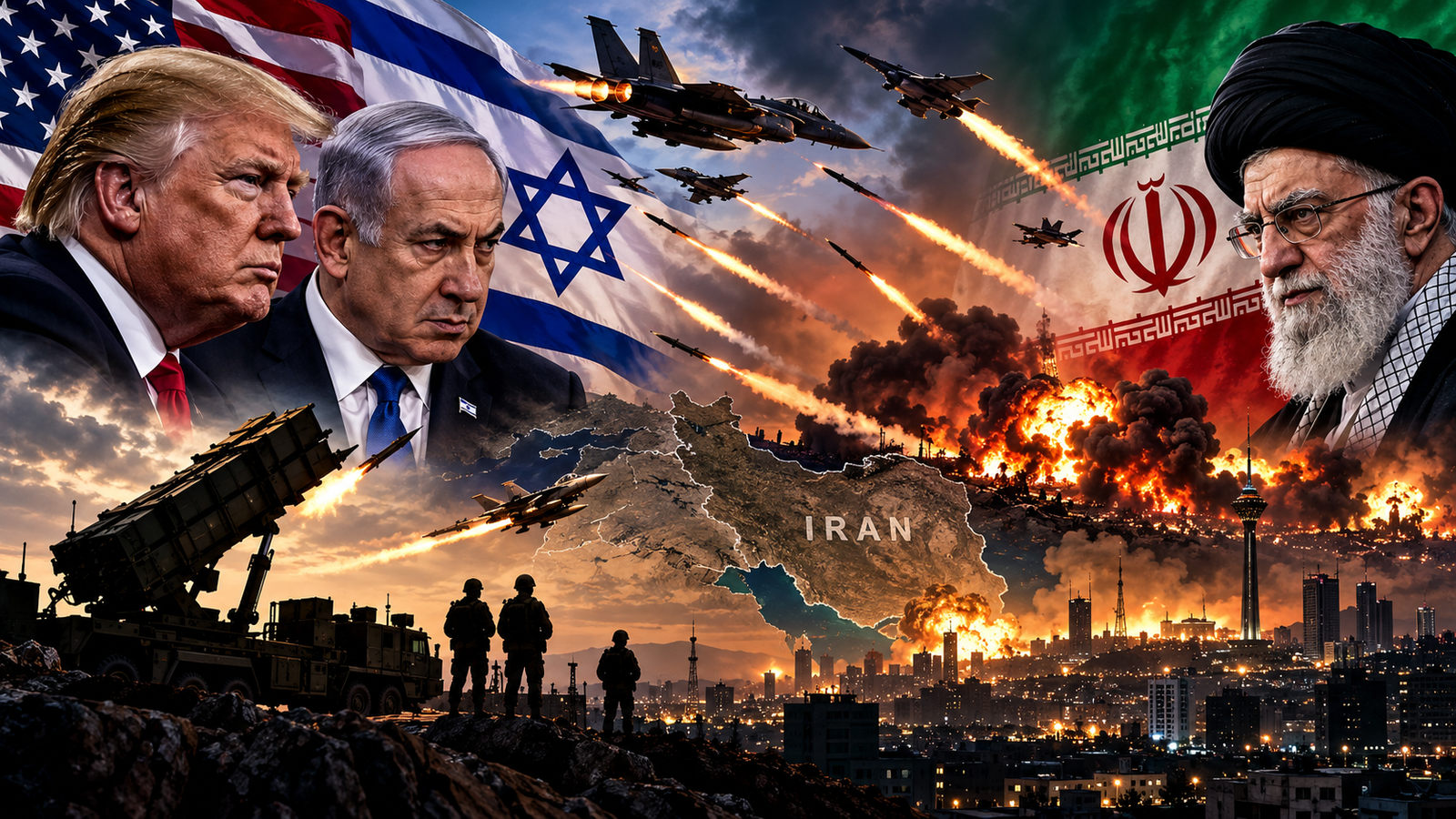
Then came Iran. When the United States and Israel went to war with Iran, the political argument became even more complicated.
Pew reported that approximately six-in-ten people in the United States believed the US made the wrong decision in using military force against Iran, while 38% said it was the right decision. The same research found that people in the United States tended to believe the war would make the US less safe rather than safer.
Again, this wasn’t unanimous. And again, the partisan divide was enormous. But the important point is that a majority of those surveyed did not believe the military action against Iran was the right decision. That creates a remarkable disconnect. The government can pursue military action. Congress can authorize or fund programs. Weapons can move. Bombs can fall. Budgets can expand. But the people paying the bills don’t necessarily agree with the direction. And that’s where the real democratic question begins.
Where does the money come from?
Government money isn’t imaginary. Every dollar Washington spends ultimately comes from somewhere — taxation, borrowing, monetary policy, or some combination of them.
Meanwhile, people in the United States are being told that difficult choices have to be made. Healthcare is too expensive. Housing is unaffordable. Infrastructure needs investment. People can’t afford childcare. College costs a fortune. Retirement feels increasingly uncertain. And then, somehow, there is always another check waiting for war. That contradiction deserves scrutiny. Not because people in the United States should ignore threats abroad. Not because Israel’s security doesn’t matter. Not because Iran doesn’t matter. Not because Hamas doesn’t matter. And certainly not because Israeli or Palestinian lives matter less. They all matter.
The question is different. What obligations does the US government have to the people who finance it? That’s the question buried inside these songs. And this isn’t about hating Israelis. That distinction matters. Criticism of the Israeli government is not criticism of Jewish people. Criticism of Netanyahu is not criticism of every Israeli. Criticism of US foreign policy is not hatred of the United States. Opposition to war is not support for Hamas or the Iranian government.
We can condemn terrorism and question war. We can care about Israeli civilians and Palestinian civilians. We can oppose antisemitism and oppose policies of the Israeli government. We can care about US national security and still ask what the hell we’re spending our money on. These things are not mutually exclusive. The political conversation becomes dishonest when criticism of a government is automatically transformed into hatred of an entire people. And it becomes equally dishonest when criticism of Hamas or Iran is used to shut down legitimate questions about US military policy.
Sometimes an argument works better as a song than as a policy paper. That’s why I made “Israel’s Burning.”
This song looks directly at the destruction, the anger, the political alliances and the moral questions surrounding the Middle East. It is intentionally uncomfortable. It isn’t designed to make everybody feel good. It’s designed to make people think.
LISTEN: “ISRAEL’S BURNING”
Then there’s “USrael Hates the World.” Yes, the title is deliberately provocative. That’s the point.
The title is political satire and protest aimed at what I see as an extraordinarily close and increasingly controversial US-Israeli foreign-policy relationship and the consequences that relationship produces around the world. It is not a literal statement that every person in the United States or every Israeli “hates the world.” It’s a protest song. And protest music is supposed to make people uncomfortable.
LISTEN: “USRAEL HATES THE WORLD”
Then comes “Economic Tsunami.” This is where the argument comes home. Because foreign policy doesn’t exist in some magical universe disconnected from ordinary people.
Wars cost money. Energy markets react. Governments borrow. Consumers pay. Families feel the consequences. And while Washington is pouring enormous resources into military priorities overseas, people inside the United States are dealing with housing costs, healthcare costs, food prices, gasoline prices and an increasingly difficult economic environment. That is the contradiction I wanted to capture.
LISTEN: “ECONOMIC TSUNAMI”
I’m not interested in telling you what political party you should support.
I’m not interested in telling you who to vote for. I’m interested in asking a question that should belong to every taxpayer:
What are we buying with our money?
- Are we buying healthcare?
- Are we buying affordable housing?
- Are we rebuilding infrastructure?
- Are we making life more affordable?
- Are we investing in US workers?
- Are we reducing the national debt?
- Are we creating a future for young people who can’t afford a house?
Or are we financing another war?
Because if the US government can somehow find enormous amounts of money when bombs are required, people have every right to ask why the same urgency doesn’t exist when people need homes, doctors, food and economic security.
That’s not a radical question. That’s a taxpayer question. That’s a democratic question. And perhaps most importantly: That’s a United States question.
The songs are my way of asking it. You don’t have to agree with me. But you should hear the question. Because when the economy is drowning and Washington keeps reaching for another match, eventually somebody has to ask who is holding the gasoline.