

When supposed “elite” playoff games turn into 40- and 50-point embarrassments, fans don’t argue about strategy — they turn the TV off.
That’s exactly what happened this postseason. Lower-ranked teams were steamrolled in matchups that never felt competitive, while higher-ranked programs with stronger résumés never even got the chance to play. It wasn’t just bad football. It was bad optics. And worse — it was predictable.
College football doesn’t have a parity problem. It has a structural problem.
The Real Issue: Opinion Masquerading as Competition
The College Football Playoff still relies on a voting committee — a subjective group tasked with comparing teams that play wildly different schedules, in different conferences, under different conditions.
That system worked when the sport was regional and limited. It doesn’t work now, in an era of national recruiting, NIL money, and de facto professional rosters.
College football already operates like a pro league. The only thing missing is a professional structure.
The Fix: Replace Opinions With Competition
The solution isn’t complicated. In fact, it already exists — just not in college football.
- From the NFL: Clear standings, divisions, and qualification based on record.
- From global soccer: Promotion and relegation.
Put them together, and the sport changes overnight.
Step 1: Abolish the Committee
No more “eye tests.” No more brand bias. No more debating hypothetical matchups.
You qualify by winning games. Period.
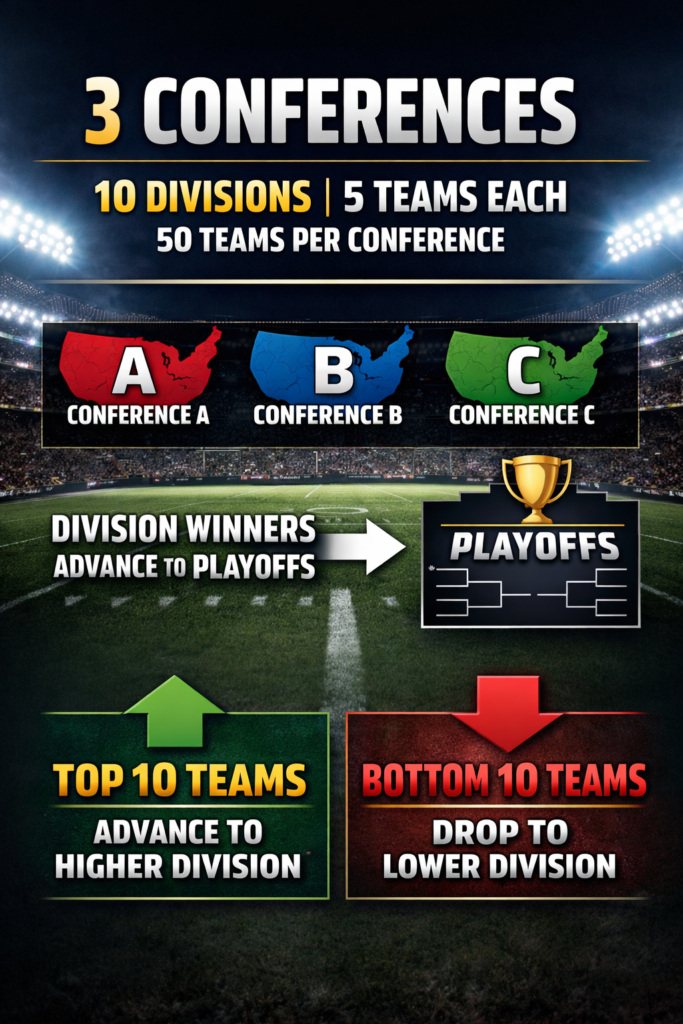
Step 2: Create a Tiered League System
College Football League Pyramid
        ┌───────────────────────┐
        │     FIRST LEAGUE       │
        │   (Top 50 Programs)    │
        │ 2 Conferences / 10 Div │
        └──────────▲────────────┘
                   │ Promotion
                   │ Relegation
        ┌──────────┴────────────┐
        │     SECOND LEAGUE      │
        │   (Next 50 Programs)  │
        └──────────▲────────────┘
                   │
        ┌──────────┴────────────┐
        │      THIRD LEAGUE      │
        │  Developmental Tier   │
        └───────────────────────┘
Each league plays a full, balanced schedule within clearly defined divisions. No scheduling gimmicks. No résumé inflation.
Step 3: Promotion and Relegation
Every season:
- Bottom 10 teams in the First League are relegated
- Top 10 teams from the Second League are promoted
- The same system applies between the Second and Third Leagues
Why This Changes Everything
| Who | What Changes |
|---|---|
| Elite teams | Can’t coast — relegation is real |
| Mid-tier teams | Have a legitimate path upward |
| Lower-tier teams | Late-season games still matter |
| Fans | Meaningful football every week |
Step 4: Playoffs Without Politics
Only First League teams qualify for the playoff.
- Division winners qualify automatically
- Remaining spots filled by record-based wild cards
No committee. No brand protection. Just football.
The Missing Piece: Talent Distribution
Structure alone isn’t enough if the best recruits all stack on the same rosters. The solution doesn’t require radical limits — just smart guardrails.
Solution 1: Draft the Top 50 Recruits
Top 50 High School Recruits
──────────────────────────
Pick 1   → Lowest-ranked First League team
Pick 2   → Next lowest
...
Pick 50  → League Champion
Only the elite enter the draft. Everyone else remains free to choose. NIL stays intact. Transfer rights remain.

Solution 2: NIL Salary Cap With Luxury Tax
Teams can exceed the NIL cap — but they pay a tax that funds competitive balance, player health, and development.
Solution 3: Recruit Slot Limits
Cap the number of Top-25 and Top-100 recruits per team. No more hoarding talent that never sees the field.
The Result: A Sport Worth Watching Again
This system delivers:
- Fewer blowouts
- Real postseason credibility
- Meaningful games from top to bottom
- Parity without destroying tradition
Final Thought
College football is already professional in everything but honesty.
Admitting that reality — and structuring the sport accordingly — isn’t radical. It’s necessary.